2026 Global Wooden Toy Market Trends: Growth & Industry Outlook
2026 Global Wooden Toy Market Report
The global wooden toy market is entering a new era. For generations, wooden toys have been associated with simple craftsmanship, natural materials, and timeless play. But in 2026, the category is evolving far beyond traditional wooden blocks and puzzles.
Today, wooden toys are increasingly connected to a new set of market forces:
So, what is really driving the global wooden toy market? Are parents buying wooden toys simply because they look beautiful? Or is something bigger happening?
The answer is both simple and complex: wooden toys are increasingly meeting the needs of modern families, brands, and retailers at the same time. Parents want toys that are safe, educational, durable, and environmentally responsible. Retailers want differentiated products with strong margins. E-commerce brands want customizable products that can help them stand out in crowded marketplaces.
This combination is creating new opportunities across the global wooden toy industry.
In this 2026 Global Wooden Toy Market Trends Report, we explore the major forces shaping the industry, changing consumer expectations, regional opportunities, emerging product categories, sustainability trends, and the future of OEM and ODM wooden toy manufacturing.
Turning market insights into winning wooden toy products?
Explore our catalog and talk to our team about your next collection.
Table of Contents
14 sections covering every major angle of the 2026 market
The Global Wooden Toy Market at a Glance
Why Is the Wooden Toy Market Growing?
The Shift from Traditional Toys to Premium Educational Products
The Five Biggest Forces Shaping the Market
Sustainability Is Reshaping Consumer Purchasing
Educational Value Is Becoming a Core Purchase Driver
Montessori and Open-Ended Play Continue to Grow
E-commerce Is Creating New Opportunities for Wooden Toy Brands
The Growth of Private Label and OEM/ODM Manufacturing
Regional Opportunities in the Global Wooden Toy Market
What Will the Wooden Toy Market Look Like in 2030?
What Does This Mean for Toy Brands and Buyers?
Conclusion
Part 1 — The Global Wooden Toy Market at a Glance
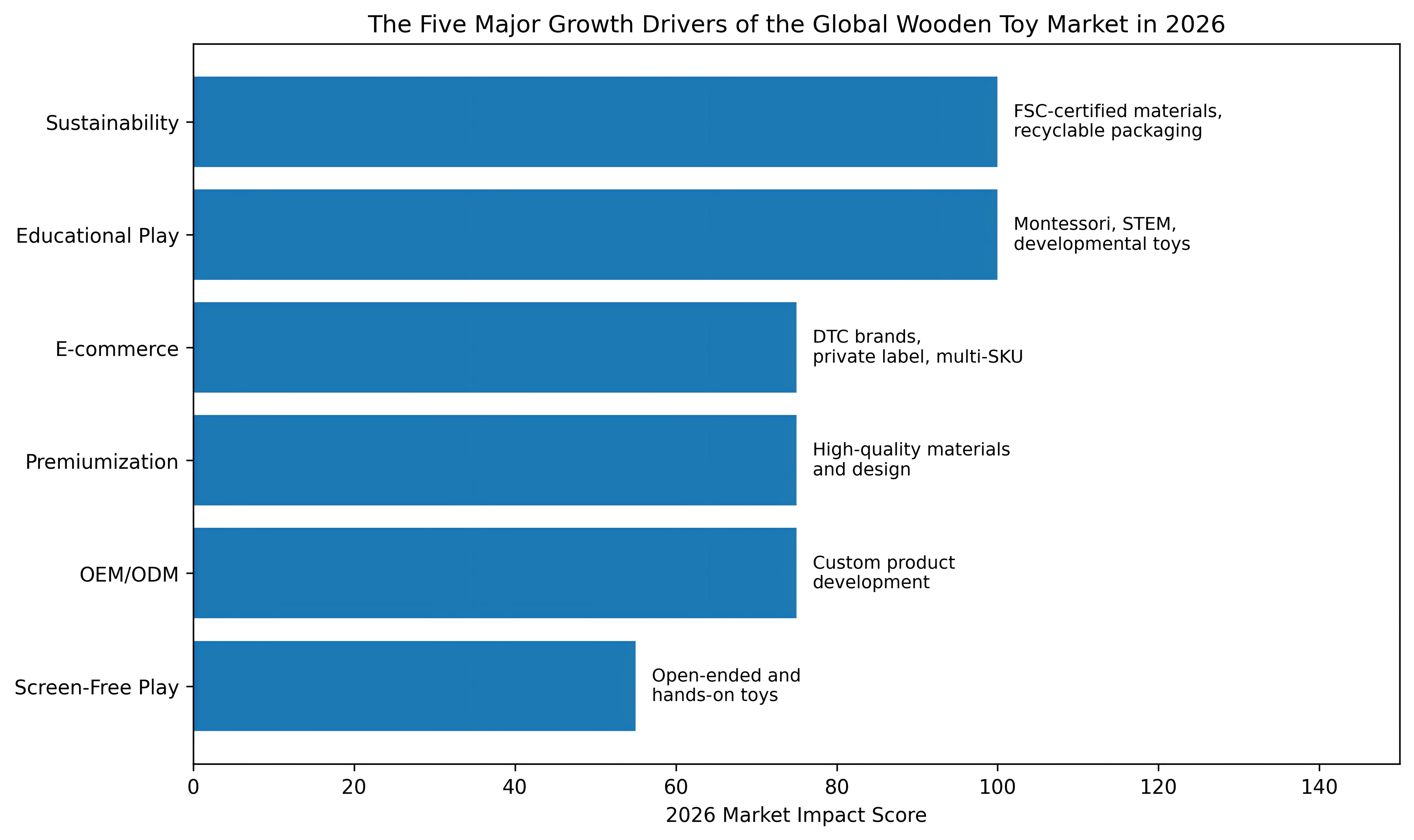
The Five Major Growth Drivers of the Global Wooden Toy Market in 2026
The global toy industry is changing as consumer priorities evolve. For many years, the toy market was heavily influenced by plastic, electronic entertainment, licensed characters, and rapidly changing trends. These categories remain important, but a growing number of consumers are looking for something different.
They are looking for toys that feel:
- More natural
- More durable
- More meaningful
- More educational
- More environmentally responsible
This is where wooden toys have a powerful advantage. A well-designed wooden toy can serve multiple purposes at once. A wooden building set can support spatial reasoning. A pretend-play kitchen can encourage communication and imagination. A balance board can support physical development. A simple wooden puzzle can help children develop concentration and problem-solving skills.
In other words, wooden toys are increasingly being purchased not just as entertainment products, but as tools for development and meaningful play.
Wooden Toys Are Moving from Traditional to Premium
The image of the wooden toy is also changing. In the past, wooden toys were sometimes viewed as simple, old-fashioned alternatives to modern plastic toys. Today, many wooden toys are positioned as premium lifestyle products.
The modern wooden toy market increasingly combines: Natural materials + thoughtful design + educational value + sustainable production. This combination allows brands to move beyond price competition.
A wooden toy with a strong design concept, high-quality materials, attractive packaging, and a clear educational purpose can occupy a very different market position from a basic mass-produced product. This is one reason premium wooden toys are increasingly popular among:
- Parents
- Montessori schools
- Educational retailers
- Independent toy brands
- Gift retailers
- E-commerce sellers
- Children's furniture brands
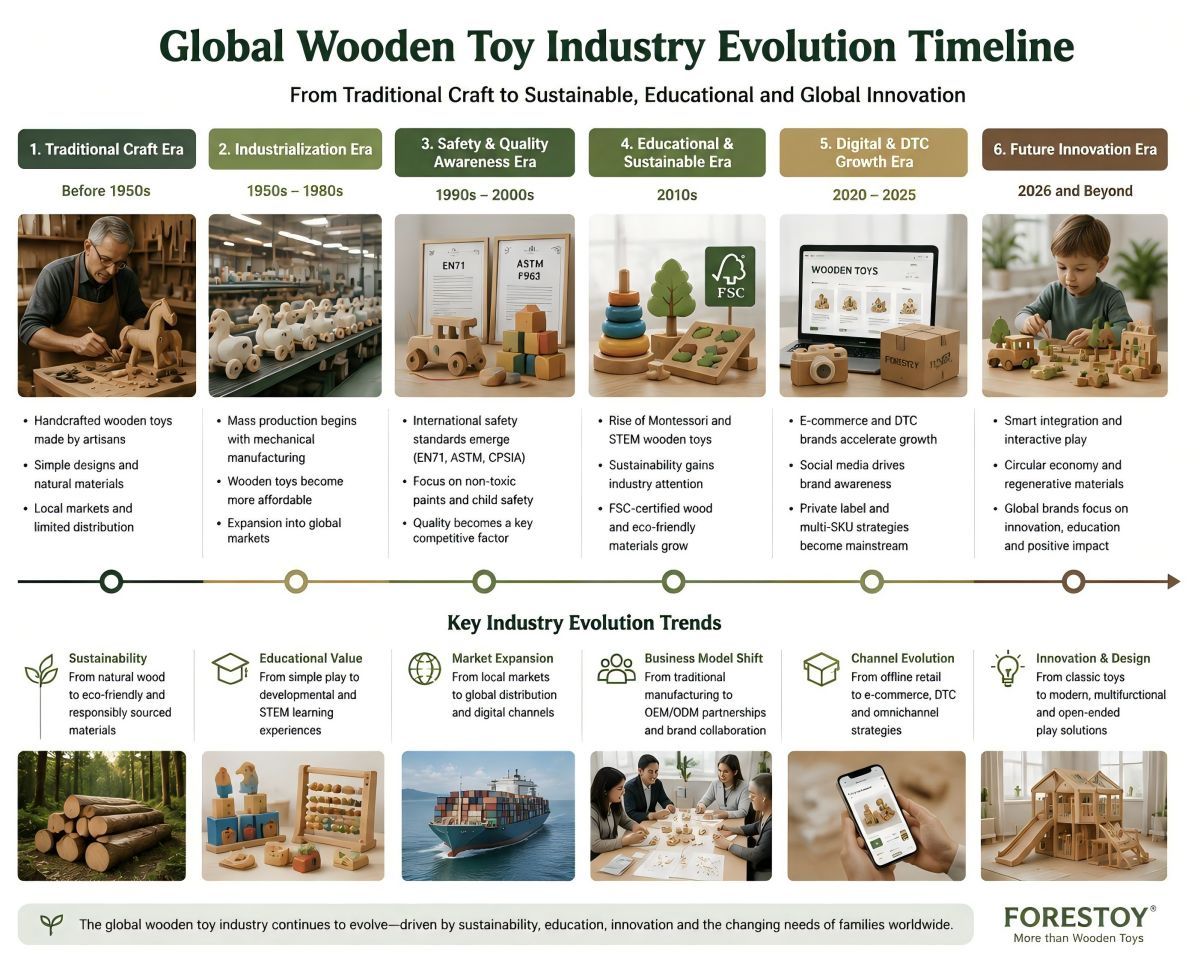
How the Wooden Toy Market Has Evolved
Wooden Toys as Traditional Products. Wooden toys were often associated with traditional craftsmanship, basic building blocks, classic puzzles, and simple educational products.
The Rise of Home-Based Play. As families spent more time at home, demand increased for indoor activities, educational toys, parent-child activities, and screen-free entertainment.
Sustainability and Premiumization. The market increasingly focused on sustainable materials, Montessori-inspired learning, premium design, e-commerce, and private-label products.
From Product Supplier to Innovation Partner. The next stage will likely focus on faster product development, customization, data-driven product design, sustainable supply chains, and integrated OEM/ODM partnerships.
Part 2 — Why Is the Wooden Toy Market Growing?
The growth is not caused by one single trend, but by several major changes at the same time
Parents Are Becoming More Conscious Consumers
Modern parents often research products extensively before making a purchase. They may ask: Is the toy safe? What materials are used? Is the paint child-safe? Will the toy support my child's development? Is the product durable? Can it be used by more than one child? Was it made responsibly?
This type of purchasing behavior benefits high-quality wooden toys. A product that can clearly demonstrate safety, durability, educational value, and responsible manufacturing has a stronger opportunity to build consumer trust.
Screen-Free Play Is Becoming More Valuable
Children are growing up in an increasingly digital world. Smartphones, tablets, video games, and streaming content are now part of everyday life. As a result, many parents are actively searching for ways to encourage more physical and creative play.
Wooden toys offer a natural alternative. They invite children to:
A wooden train set does not tell a child exactly what to do. A set of building blocks does not come with only one possible solution. That freedom is precisely what makes these toys valuable.
Sustainable Consumption Is Becoming Mainstream
Environmental concerns are influencing purchasing decisions in many major markets. Consumers are increasingly aware of material sourcing, plastic waste, packaging waste, product durability, and manufacturing practices.
This does not mean every consumer will choose the most expensive sustainable product. However, it does mean sustainability is becoming a more important part of the overall value proposition. A durable wooden toy that can be passed from one child to another offers a very different consumption model from a low-cost product designed for short-term use.
Montessori and Educational Parenting Are Expanding
Parents increasingly view play as an important part of learning. This has created strong demand for toys that support:
- Fine motor skills
- Problem-solving
- Language development
- Creativity
- Concentration
- Early mathematics
- Practical life skills
Wooden toys are naturally suited to these educational approaches.
E-commerce Has Lowered the Barrier for New Brands
In the past, launching a toy brand often required significant retail distribution. Today, an entrepreneur can develop a product, build a brand, create an online store, and reach customers in multiple countries.
This has created strong demand for private-label products, custom designs, small-batch launches, multi-SKU collections, and custom packaging. As a result, the relationship between toy brands and manufacturers is changing rapidly.
Part 3 — The Shift from Traditional Toys to Premium Educational Products
One of the most important changes: from commodity products to value-added products
A Commodity Product Competes On
- Price
- Availability
- Basic functionality
A Value-Added Product Competes On
- Design
- Educational value
- Brand story
- Sustainability
- Quality
- Customer experience
Consider two wooden stacking toys. The first is simply described as: "A wooden stacking toy." The second is positioned as: "A sustainably produced early-learning toy designed to help children develop hand-eye coordination, concentration, and problem-solving skills through open-ended play."
The physical product may be similar. But the perceived value is completely different. This is why product positioning is becoming increasingly important in the wooden toy market.
Premiumization Is Creating New Opportunities
Premiumization does not necessarily mean making every product expensive. It means creating a stronger overall value proposition. A premium wooden toy may include:
- Better wood selection
- More refined sanding
- Higher-quality coatings
- More thoughtful design
- Stronger educational value
- More attractive packaging
- Better documentation
- A clear brand story
This allows brands to compete on more than unit cost.
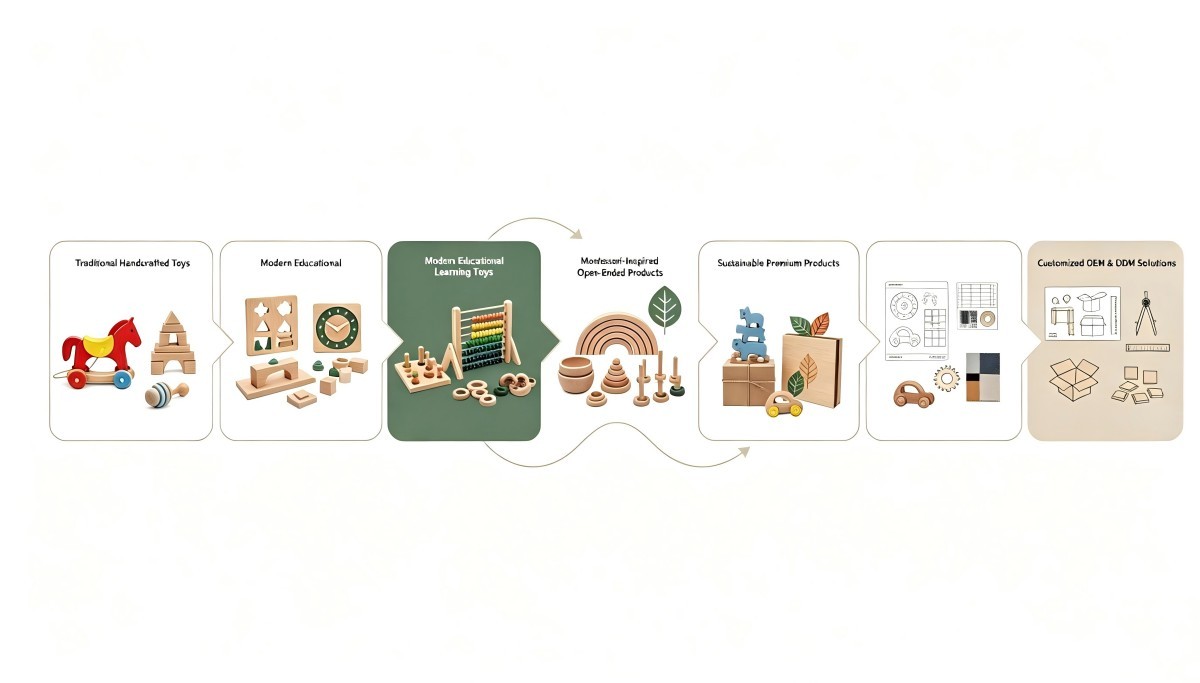
Part 4 — The Five Biggest Forces Shaping the Market
The global wooden toy market in 2026 is being shaped by five major structural changes
From Low-Cost Production to Value Creation
Simply offering a lower price is becoming more difficult as manufacturing capabilities become more widely available, e-commerce increases price transparency, and online marketplaces become more crowded. Successful brands need to create additional value through product design, educational positioning, sustainability, customization, packaging, and brand storytelling. The question is no longer simply "How cheaply can this toy be manufactured?" but "Why should a customer choose this product instead of another one?"
From Plastic Products to Sustainable Materials
Plastic remains an important material, but many brands are actively exploring alternatives or reducing unnecessary plastic use. Wooden toys benefit from this shift because wood naturally communicates warmth, natural beauty, durability, and craftsmanship. This is especially relevant in markets where consumers actively look for FSC-certified materials, recyclable packaging, reduced plastic, non-toxic coatings, and responsible supply chains.
From Entertainment to Developmental Play
The definition of a good toy is changing. Parents increasingly ask: "What will my child learn while playing with this product?" The strongest products combine learning and fun naturally — a pretend-play kitchen encourages language development, a construction set introduces engineering concepts, a puzzle develops problem-solving skills while remaining entertaining.
From Transactional Suppliers to Strategic Partners
Many brands need support much earlier in the development process — design feasibility, material selection, engineering, prototype development, safety considerations, packaging, and cost optimization. This creates opportunities for experienced OEM and ODM manufacturers to become strategic partners who identify potential problems before mass production begins, helping reduce development delays, product revisions, material waste, compliance risks, and production problems.
From Offline Retail to Omnichannel Commerce
Modern wooden toy brands increasingly operate across brand websites, Amazon, online marketplaces, social commerce, specialty retailers, educational distributors, and physical stores. Product development must consider multiple sales environments: a product sold online may require strong photography, clear packaging, compact shipping dimensions, and easy assembly instructions, while specialty retail requires premium shelf presentation and strong storytelling.
How Consumers Choose Wooden Toys in 2026
Modern consumers rarely purchase children's products based on a single factor
Discover
Consumers discover products through Google Search, social media, online marketplaces, influencers, and retail stores.
Evaluate
They compare materials, safety, price, design, and reviews.
Verify
They look for certifications, product details, brand reputation, and customer reviews.
Purchase
The final decision is influenced by value, trust, convenience, and brand positioning.
Recommend
A positive experience may lead to repeat purchases, word-of-mouth recommendations, and social sharing.
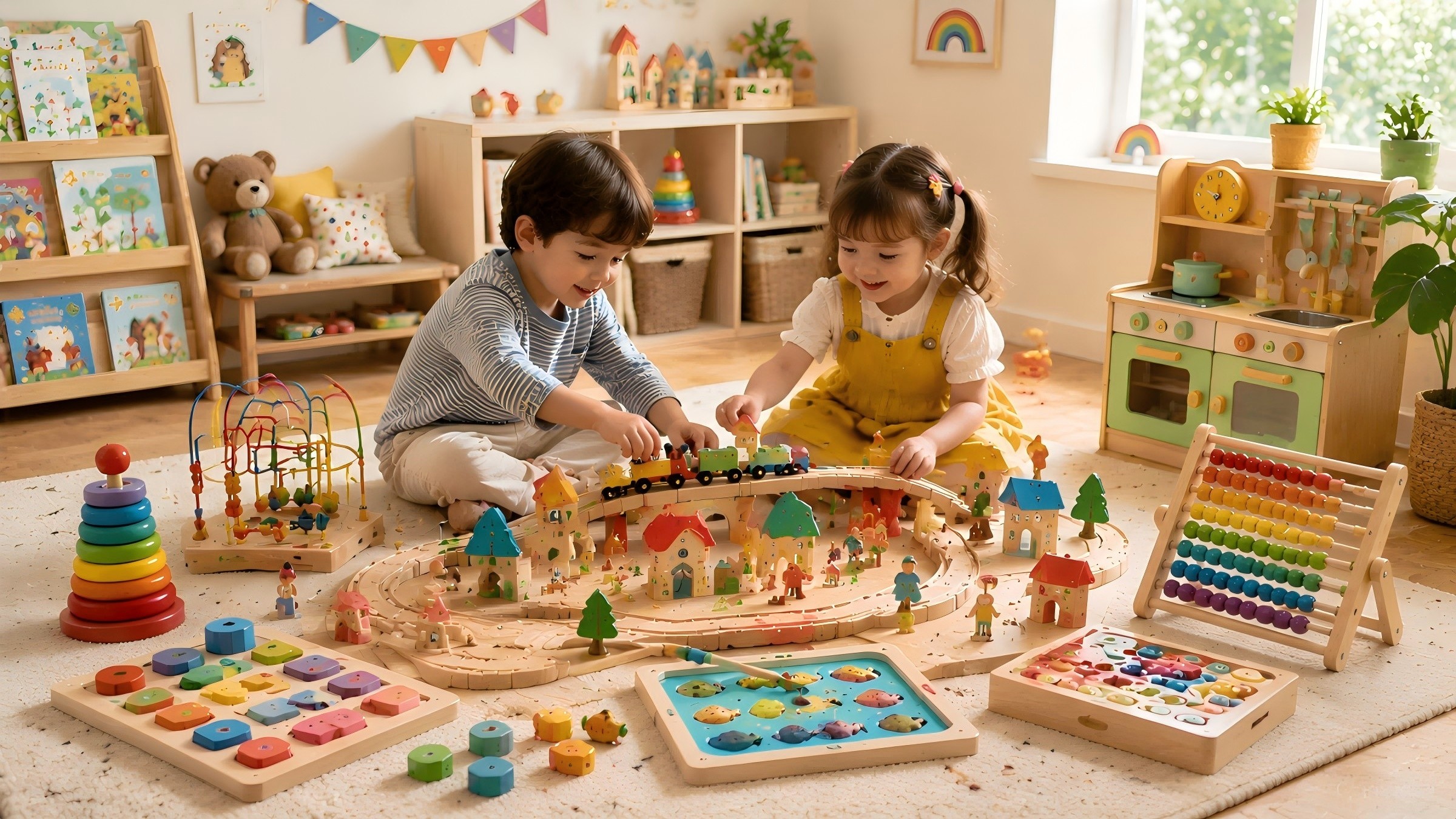
Part 5 — Sustainability Is Reshaping Consumer Purchasing
Sustainability is one of the most important long-term forces influencing the wooden toy industry
Sustainability should not be treated simply as a marketing slogan. For consumers, it increasingly involves the entire product lifecycle:
FSC-Certified Wood Is Increasingly Important
FSC certification is widely recognized as an indicator of responsible forest management and supply chain traceability. For brands selling in environmentally conscious markets, FSC-certified materials can provide important value. However, certification is only one part of a broader sustainability strategy.
Brands should also consider product durability, material efficiency, packaging design, production waste, transportation, and end-of-life considerations. A sustainable product is not simply defined by one material — it is defined by the decisions made throughout the product development process.
Packaging Is Becoming Part of the Sustainability Story
Toy packaging has traditionally relied heavily on plastic components. However, more brands are now exploring recycled cardboard, kraft paper, paper-based inserts, molded pulp, and reduced packaging volume. This can create several benefits:
Environmental Benefits
Less plastic waste and more recyclable materials.
Commercial Benefits
A strong sustainability story can help differentiate a product.
Logistics Benefits
Optimized packaging can potentially reduce shipping volume and transportation costs.
The best packaging strategy balances: Protection + Presentation + Sustainability.
Part 6 — Educational Value Is Becoming a Core Purchase Driver
The modern educational toy market is much broader than traditional learning products
Fine Motor Development
Products such as peg boards, threading toys, busy boards, and puzzles can encourage hand control and coordination.
Cognitive Development
Products such as shape sorters, matching games, counting toys, and logic puzzles can encourage problem-solving and early mathematical thinking.
Social & Emotional Development
Pretend play can help children practice communication, explore emotions, understand social roles, and develop storytelling skills.
Physical Development
Balance toys, climbing products, and outdoor play equipment can encourage coordination, strength, balance, and confidence.
The strongest products often support several developmental areas simultaneously.
Part 7 — Montessori and Open-Ended Play Continue to Grow
Montessori-inspired products remain highly relevant to the global wooden toy market
The underlying philosophy emphasizes independence, hands-on exploration, practical learning, concentration, and self-directed activity. Wooden toys are naturally compatible with these principles.
What Makes a Toy Open-Ended?
An open-ended toy can be used in many different ways. For example, a set of wooden blocks might become a house, a bridge, a tower, a city, or a castle — the child creates the meaning. This is different from a toy with only one fixed function.
Open-ended toys encourage children to become active creators rather than passive users. That is particularly valuable in an age when many digital products are designed to control attention. Explore our Montessori and open-ended wooden toys collection.
Part 8 — E-commerce Is Creating New Opportunities for Wooden Toy Brands
E-commerce has fundamentally changed how toy brands enter the market
A new brand no longer necessarily needs to secure major retail distribution before launching. Instead, it can: develop a product, create a brand, build an online store, test market demand, collect customer feedback, and expand the product range. This has created new opportunities for smaller brands.
Product Design for E-commerce
Online products need to communicate value quickly. Consumers may decide whether to click on a product based on the main product image, product title, price, reviews, and brand presentation. Packaging also matters — a product that arrives damaged can create a poor customer experience even if the product itself is excellent. Therefore, e-commerce product development should consider package dimensions, drop resistance, assembly instructions, product photography, and shipping efficiency.
Designing Wooden Toys for Online Sales
For e-commerce brands, a successful wooden toy must work in two environments: the physical play environment and the digital shopping environment. Before customers purchase the product, they may evaluate it through product photography, product videos, product dimensions, product descriptions, customer reviews, and packaging presentation.
A product may need to be visually distinctive, easy to explain online, efficient to package, suitable for shipping, simple to assemble, and appropriate for the target market. For brands developing private-label collections, a capable manufacturing partner can help coordinate product customization, packaging design, production, and quality control. For more information, explore Forestoy's Custom Wooden Toys for E-commerce & Private Label Brands.

Part 9 — The Growth of Private Label and OEM/ODM Manufacturing
The growth of e-commerce has also increased demand for private-label products
Many brands want to create products that are different from mass-market products, consistent with their brand identity, customizable, and suitable for their target market. This is where OEM and ODM manufacturing become important.
OEM Manufacturing
In an OEM model, the customer typically provides the product concept or design, while the manufacturer handles production. Typical customization may include materials, colors, sizes, logos, and packaging.
ODM Manufacturing
In an ODM model, the manufacturer may provide more extensive product development support, including product concepts, design suggestions, engineering, prototyping, and material recommendations. For emerging brands, ODM cooperation can help reduce the time and resources required to develop a new product line.
Part 10 — Regional Opportunities in the Global Wooden Toy Market
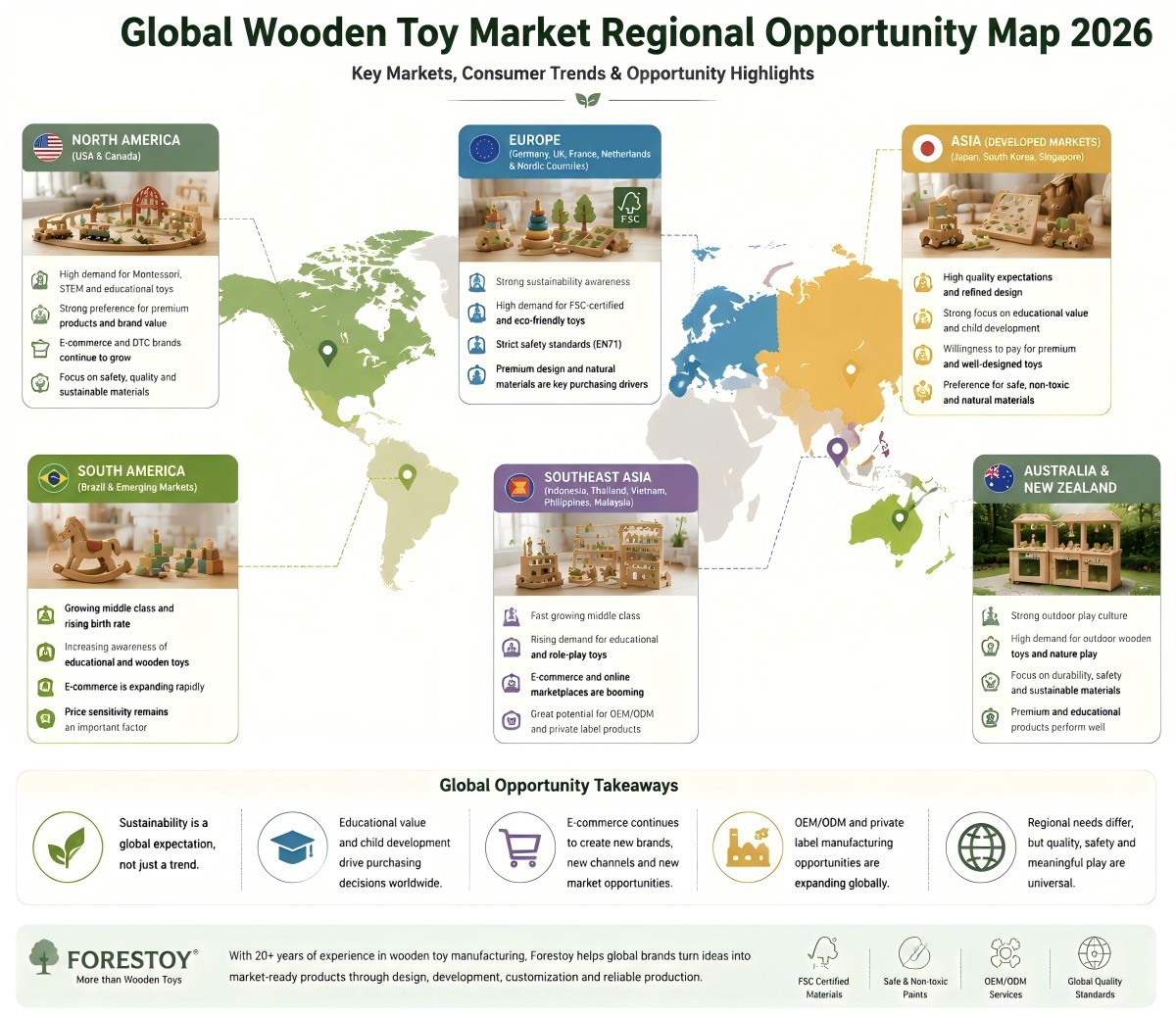
The global market is not uniform — consumer expectations vary by region
North America
North American consumers often value educational benefits, Montessori concepts, STEM learning, online reviews, convenience, and premium design. Popular product categories include learning towers, wooden train sets, building toys, pretend-play products, and puzzles. The region also remains highly attractive for private-label and e-commerce brands.
Europe
European markets place strong emphasis on sustainability, product safety, material traceability, and responsible manufacturing. Germany, the United Kingdom, the Netherlands, France, Spain, Italy, and Nordic countries all offer opportunities for premium wooden toy brands. Products with strong environmental positioning often have particular appeal.
Asia-Pacific
Asia-Pacific is one of the most dynamic regions for long-term growth. Growing demand is supported by rising household incomes, increased education spending, premium parenting, urbanization, and e-commerce. Japan, South Korea, Singapore, Australia, and emerging Southeast Asian markets all present different opportunities.
Australia & New Zealand
Outdoor play is particularly important in these markets. Potentially attractive categories include mud kitchens, balance toys, sand play products, outdoor activity toys, and nature exploration products.
What Will the Wooden Toy Market Look Like in 2030?
While no one can predict the future with complete certainty, several trends appear likely to continue
Sustainability Will Become an Expectation. Sustainability may increasingly become a baseline requirement rather than a unique selling point.
Product Differentiation Will Become More Important. As online competition increases, brands will need stronger design and storytelling.
Educational Play Will Continue to Expand. Parents will continue looking for products that support development naturally.
Customization Will Become More Accessible. Smaller brands will increasingly seek custom products and flexible manufacturing solutions.
Manufacturers Will Become More Involved in Innovation. The best manufacturers will not simply produce products — they will help create them.
Where Are the Biggest Opportunities in the Wooden Toy Market?
Success will require more than simply choosing wooden materials
1. What Problem Does the Product Solve?
Does it support learning? Encourage creativity? Promote physical activity? Create family interaction?
2. Who Is the Target Customer?
A product for a Montessori school may require a different approach from a product designed for a gift retailer.
3. What Makes the Product Different?
Design, material, function, packaging, and storytelling can all create differentiation.
4. Can the Product Meet International Safety Requirements?
Compliance should be considered early in product development.
5. Can the Manufacturing Partner Support Long-Term Growth?
The ideal partner should be able to support more than one product. As a brand grows, it may need more SKUs, new product categories, new packaging, new markets, and larger production capacity. Choosing the right partner early can make future growth much easier.
Conclusion: The Future of Wooden Toys Is Sustainable, Educational, and Collaborative
The global wooden toy market is entering an exciting new stage. The category is benefiting from several powerful trends: growing environmental awareness, demand for educational play, the popularity of Montessori-inspired products, the search for screen-free childhood experiences, expansion of e-commerce, growth of private-label brands, and increasing demand for OEM and ODM cooperation.
But the future will not belong to every wooden toy brand. The strongest companies will be those that combine good design + meaningful play + responsible materials + reliable manufacturing.
The wooden toy industry is no longer simply about producing products from wood. It is about creating better experiences for children, better value for parents, and stronger opportunities for brands. For manufacturers, the role of a supplier is evolving from a production provider into a product development partner.
At Forestoy, we believe the future of wooden toys should be: Natural in material. Thoughtful in design. Safe for children. Responsible for the planet.
With more than 20 years of experience in wooden toy manufacturing, Forestoy supports global brands, retailers, wholesalers, distributors, and e-commerce businesses with comprehensive OEM and ODM solutions. From product concept and design optimization to prototyping, testing, packaging, and mass production, our team helps turn ideas into market-ready wooden toys.
Explore More Insights from the 2026 Global Wooden Toy Market Trends Series
Deepen your market knowledge with our related reports
Discover the Top 10 Wooden Toy Industry Trends in 2026
From sustainable materials and Montessori learning to open-ended play, e-commerce, and customized manufacturing, discover the trends shaping the future of the industry.
Read: Top 10 Wooden Toy Industry Trends Shaping the Global Market in 2026
Explore Global Wooden Toy Consumer Trends
Discover how consumer preferences differ across North America, Europe, Asia-Pacific, Australia, and other important markets.
Read: Global Wooden Toy Consumer Trends: Regional Market Insights for 2026
Discover the Best Wooden Toy Categories for 2026
Explore the fastest-growing product categories, material choices, sustainability strategies, and international toy safety requirements.
Read: Best Wooden Toy Categories for 2026: Sustainability, Materials & Global Safety Standards
Learn About the Future of OEM and ODM Wooden Toy Manufacturing
Discover how the relationship between toy brands and manufacturers is changing — and how the right manufacturing partner can support long-term growth.
Read: The Future of Wooden Toy Manufacturing: OEM, ODM & Global Supply Chain Trends
Ready to Develop Your Next Wooden Toy Collection?
Whether you are launching a new toy brand, expanding an existing product line, developing a Montessori collection, creating a private-label range, looking for a reliable OEM partner, or exploring a new educational toy concept — Forestoy can help you move from concept to production.
Have a product idea? Let's explore what we can build together.

Frequently Asked Questions About the Global Wooden Toy Market
Key questions from brands and buyers, answered
Is the global wooden toy market growing in 2026?
Yes. The wooden toy category continues to benefit from growing consumer interest in sustainability, educational play, Montessori-inspired products, screen-free activities, and premium children's products. However, the growth of individual product categories can vary significantly by region, price segment, distribution channel, and consumer group.
Why are wooden toys becoming more popular?
Wooden toys are becoming more popular because they combine several benefits that modern consumers value, including durability, natural materials, educational value, open-ended play, and sustainability.
Are wooden toys more sustainable than plastic toys?
Wooden toys can offer sustainability advantages when responsibly sourced wood, appropriate coatings, durable designs, and recyclable packaging are used. However, sustainability depends on the entire product lifecycle, including material sourcing, manufacturing, packaging, transportation, and product lifespan.
What are the most popular wooden toy categories in 2026?
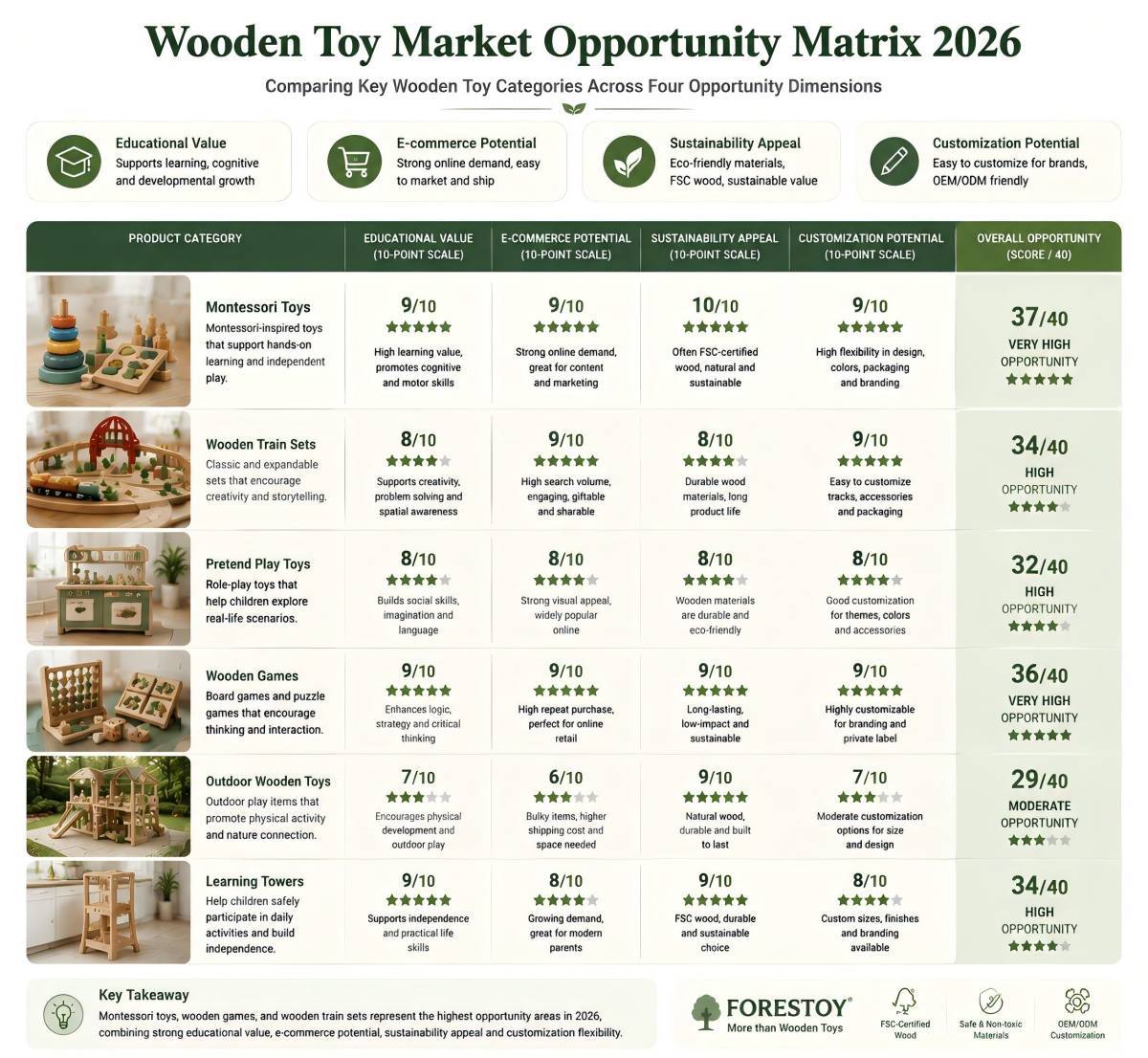
Important categories include Montessori learning toys, wooden construction toys, pretend-play toys, wooden puzzles, wooden games, wooden train sets, outdoor wooden toys, and learning towers and children's furniture.
What is the difference between OEM and ODM wooden toy manufacturing?
OEM manufacturing generally involves producing a product according to the buyer's design or specifications. ODM manufacturing typically involves more extensive manufacturer support, including product development, design optimization, engineering, prototyping, and material recommendations.
What certifications should buyers look for when sourcing wooden toys?
The appropriate certifications depend on the target market. Common requirements may include EN71 for the European market, ASTM F963 for the United States, CPSIA requirements for children's products in the United States, AS/NZS ISO 8124 for Australia and New Zealand, and FSC certification for responsibly sourced wood. Requirements should always be confirmed according to the specific product and target market.
How can I find a reliable wooden toy manufacturer?
When evaluating a manufacturer, consider experience, product development capabilities, quality control, safety testing, material sourcing, communication, production capacity, and previous international market experience. A reliable manufacturer should be able to support more than just mass production.
Have a wooden toy project in mind?
Whether you are launching a new brand, expanding your existing product line, or searching for a reliable manufacturing partner, Forestoy can help you move from concept to production. Share your product idea with our team and discover how we can help bring it to life.