EN71 vs ASTM F963 vs CPSIA: What Toy Buyers Need to Know
Oct 30,2026
Forestoy | Toy Safety & Compliance
EN71 vs ASTM F963 vs CPSIA: What Toy Buyers Need to Know
A Practical Guide to Toy Safety Standards for Importers, Retailers, and Wooden Toy Brands
Published by Forestoy Wooden Toy Manufacturing Team | Updated October 2026
If you are sourcing wooden toys from China, understanding international toy safety standards is one of the most important steps in protecting customers, your brand, and your business. Three names frequently appear in toy testing reports and supplier quotations: EN71, ASTM F963, and CPSIA.
According to the U.S. Consumer Product Safety Commission (CPSC), approximately 267,100 toy-related injuries were treated in U.S. hospital emergency departments in 2024; approximately 66% involved children aged 12 or younger. These are toy-related injury estimates, not a count of defective products.
Forestoy has developed and manufactured wooden toys since 2003. Our approach is simple: toy safety should be built into product development, not left until the final shipment inspection.
1. EN71 vs ASTM F963 vs CPSIA: Key Differences
EN71 is a family of European toy safety standards; ASTM F963 is the principal U.S. toy safety specification made mandatory through federal regulations; CPSIA is U.S. legislation establishing broader children’s product compliance obligations.
Children’s Product Certificate (CPC), when applicable
Age scope
Applicable toy requirements
Generally toys for under-14s
Children’s product rules often focus on age 12 and under
Key takeaway
An EN71 test report does not establish U.S. compliance. Likewise, an ASTM F963 report does not replace the EU conformity assessment process.
2. What Is EN71? European Toy Safety Standards
EN71 supports the European Union toy safety framework. As of October 2026, Directive 2009/48/EC remains the principal applicable framework. Regulation (EU) 2025/2509 entered into force January 1, 2026; its main requirements apply from August 1, 2030.
EN71-1: Mechanical and Physical Properties
EN71-1 addresses small parts, sharp edges and points, structural strength, detachable components, accessible fasteners, entrapment, cords and other physical hazards. A toddler’s wooden shape sorter must be evaluated for foreseeable use and abuse, not just its appearance when new.
EN71-2: Flammability
EN71-2 addresses flammability for relevant toys and materials. Its application depends on product design; wooden play kitchens with fabric accessories, for example, should be assessed according to the actual materials and relevant provisions.
EN71-3: Migration of Certain Elements
EN71-3 addresses migration of 19 elements, including lead, cadmium, chromium, arsenic and mercury. Material categories include dry/brittle/powder-like/pliable materials, liquid or sticky materials, and scraped-off materials. The standard measures migration under defined conditions, not simply total elemental concentration.
For painted wooden toys, buyers should request evidence covering the actual coating systems and relevant components. “Non-toxic paint” is not a substitute for product-specific evidence.
Does EN71 Testing Mean a Toy Is CE Certified?
No. The manufacturer must complete the applicable conformity assessment, prepare technical documentation, issue an EU Declaration of Conformity and affix the CE marking. Depending on the circumstances, internal production control or notified-body assessment may apply. CE marking is not a certificate automatically issued by a laboratory.
3. What Is ASTM F963? The U.S. Toy Safety Standard
ASTM F963, Standard Consumer Safety Specification for Toy Safety, is developed by ASTM International and enforced through applicable CPSC rules. ASTM F963-23 became mandatory for applicable toys manufactured on or after April 20, 2024.
The standard addresses mechanical and physical hazards, small objects, sharp edges, material quality, certain chemical hazards, magnets, sound-producing toys, cords, folding mechanisms, and relevant warnings. Not every section applies to every toy.
ASTM F963 Testing for Wooden Toys
Consider a wooden magnetic fishing game. Assessment may involve mechanical strength, detachable parts, magnet retention, coatings and appropriate age grading. An experienced manufacturer should identify hazards during prototyping rather than waiting for a failed final test.
Is Third-Party Testing Required?
For toys intended primarily for children 12 or younger, applicable mandatory toy safety requirements generally require testing by a CPSC-accepted third-party laboratory, subject to exceptions and testing relief. The CPSC publishes an applicability chart identifying relevant ASTM F963 sections.
4. What Is CPSIA? U.S. Children’s Product Compliance
The Consumer Product Safety Improvement Act of 2008 is legislation, not a single testing method. It strengthened federal rules on restricted substances, third-party testing, certification and traceability.
Lead Content Limits
The general federal total lead content limit for accessible component parts of children’s products is 100 ppm (0.01%); the lead limit for paint and similar surface coatings is 90 ppm (0.009%). A painted wooden puzzle may need assessment of both its substrate and its surface coating.
Phthalate Restrictions
U.S. rules restrict eight specified phthalates in applicable children’s toys and child care articles, generally at 0.1% (1,000 ppm) each in accessible components. Wood-based products are not automatically exempt if they contain relevant flexible plastics or other regulated materials.
Children’s Product Certificate (CPC)
For applicable imported children’s products, the U.S. importer generally issues the CPC based on supporting compliance evidence. It identifies the product, applicable rules, responsible certifier, manufacturing and testing information, relevant laboratory, and records contact. A CPC is not the same as a laboratory test report.
Tracking Labels
Children’s products must meet applicable tracking-label requirements, generally providing permanent distinguishing information on the product and packaging to the extent practicable, supporting traceability to manufacturing location, date and batch.
5. EN71 vs ASTM F963: Can One Test Cover Both Markets?
Both frameworks address many of the same hazards, but test methods, age-related criteria, chemical limits, labels and documentation may differ. A painted wooden block set sold in Germany and the United States needs an EU conformity assessment and compliance with applicable U.S. federal rules. Technical evidence can sometimes be coordinated, but neither regime should be assumed to replace the other.
Best practice
Design to both markets’ applicable requirements before the prototype is finalized.
6. Why Wooden Toy Safety Requires More Than Testing
Wooden stacking toys must pass mechanical and small-parts assessments, not only chemical tests.
Wood and Structural Quality
Beech, birch, rubberwood, pine and plywood have different properties. Wood strength, moisture, splintering, structural stability and workmanship matter even when chemical tests pass.
Paints, Coatings and Adhesives
Water-based paint is not automatically compliant. Buyers should review material specifications, incoming checks, approved formulations and batch records.
Small Parts and Age Grading
A component may become hazardous after breakage. Drop, torque, tension and other applicable tests help assess foreseeable use. A “3+” label cannot simply be used to avoid requirements when the toy is intended for younger children.
7. How Forestoy Builds Safety into Product Development
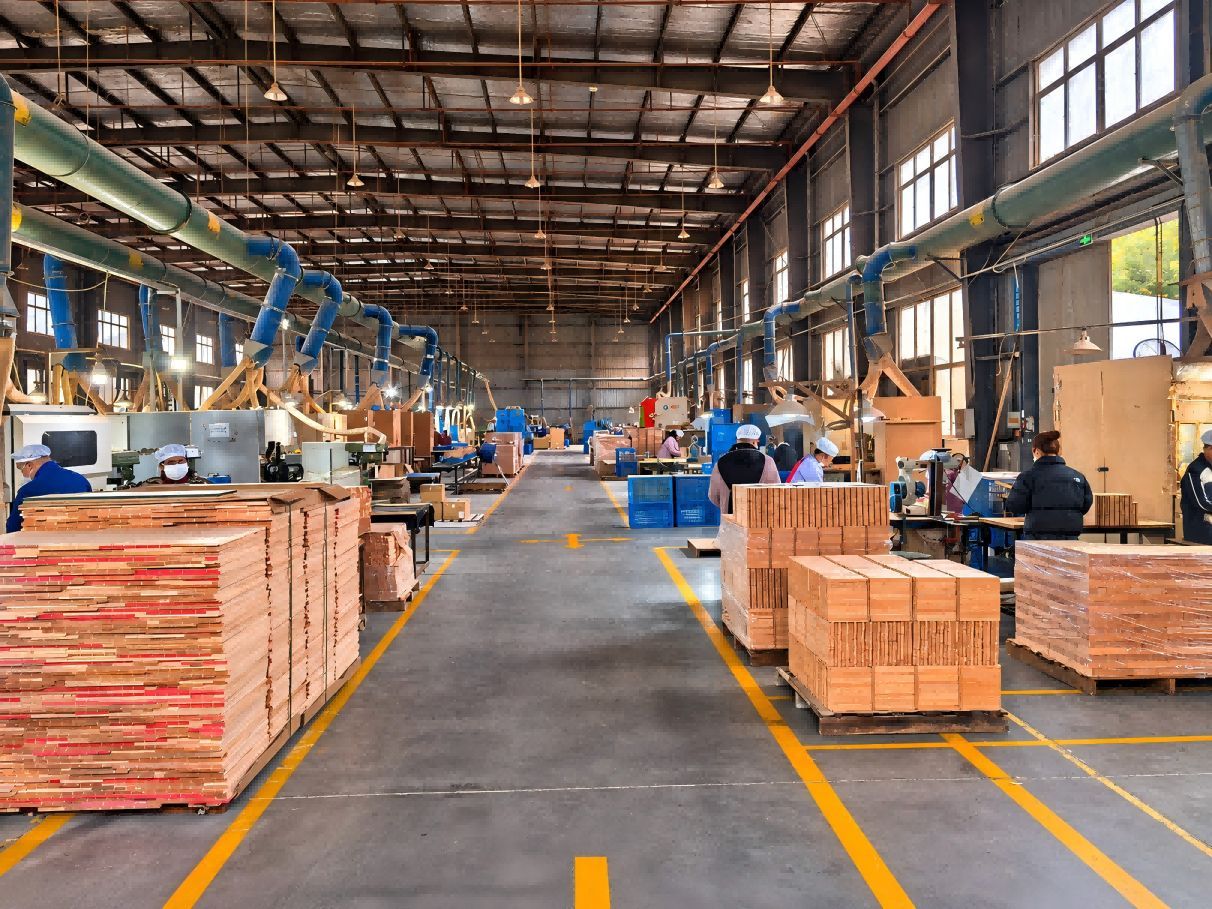
Since 2003, Forestoy has developed more than 1,500 products, including puzzles, educational toys, wooden games and Montessori-inspired products. Our workflow combines design review, prototyping, in-house screening, independent testing coordination and production quality control.
Wood selection and workshop workmanship directly affect structural quality beyond laboratory test results.
Preliminary unpainted prototypes support structural review before the final coatings and artwork are applied. Design changes can then be made before mass production.
Step 3: Internal Screening
Our stated equipment includes torque/tension meters, drop testers, sharp-edge testers, bite-force testing equipment, small-parts cylinders, XRF screening and other analytical instruments. Internal screening supports quality monitoring but does not replace mandatory qualified third-party testing.
Step 4: Independent Testing
Depending on the project, Forestoy coordinates with independent testing organizations such as SGS, TÜV, Bureau Veritas and Intertek. For U.S. mandatory third-party testing, the laboratory must be CPSC-accepted for the relevant scope.
Step 5: Production Consistency
Incoming materials, sanding, painting, assembly, batch sampling and shipment inspections help maintain consistency with approved samples. Learn more about Forestoy manufacturing capacity and quality control.
Illustrative image: toy safety evaluation, mechanical testing and supplier quality review (AI-generated; not documentary evidence of Forestoy facilities).
8. How to Verify a Wooden Toy Supplier’s Compliance
Request product-specific reports: Verify model, materials, coatings and relevant components.
Confirm standard versions: Match rules to manufacture and market-placement timelines.
Verify laboratories: Confirm accreditation and CPSC acceptance where relevant.
Review the material list: Include wood, coatings, adhesives, magnets and accessories.
Assess factory controls: Ask about incoming inspection, production changes and traceability.
Clarify certificate ownership: Identify EU conformity-document responsibilities and U.S. CPC certifier.
Reassess modifications: Material or design changes may trigger additional testing.
9. Five Common Importer Mistakes
Assuming EN71 compliance automatically covers the United States.
Treating a test report as the complete certification package.
Testing only after mass production is complete.
Overlooking warnings, labeling and packaging details.
Confusing FSC forest certification or BSCI social-compliance assessment with product safety certification.
10. EU and U.S. Compliance Checklist
Item
EU
United States
Product and age classification
Confirm
Confirm
Mechanical/chemical safety
Applicable EN71 and EU rules
Applicable ASTM F963 and federal rules
Flammability
Relevant EN71-2
Relevant federal/ASTM rules
Certification
EU DoC, CE and technical file
CPC and supporting records where applicable
Labels
CE and required warnings
Tracking labels and warnings
Production consistency
Verify controls
Verify controls and applicable periodic testing
11. Frequently Asked Questions
What is the main difference between EN71 and ASTM F963?
EN71 is a European standards series; ASTM F963 is the principal U.S. toy safety specification. Their technical details and regulatory frameworks differ.
Is ASTM F963 the same as CPSIA?
No. ASTM F963 is a technical standard; CPSIA is federal legislation governing broader children’s product compliance.
Do wooden toys need both standards?
Only when required by their intended markets. Products sold in both the EU and U.S. must satisfy each jurisdiction’s applicable rules.
Does a toy need both CE marking and a CPC?
A dual-market product may need EU CE documentation and a U.S. CPC, depending on product classification and applicable rules.
Can Chinese manufacturers support both markets?
Yes. Experienced manufacturers can coordinate testing and product development, while buyers verify exact scopes and compliance responsibilities.
12. Request Forestoy’s Factory Audit & Toy Safety Support Package
Your toy supplier should do more than manufacture an attractive product. They should help identify safety risks before those risks become commercial problems.
Forestoy supports international toy brands, retailers and importers with OEM/ODM wooden toy development, material selection, prototype evaluation, manufacturing and testing coordination.
Ask our team about: available FSC/BSCI qualification documents; quality control procedures and testing equipment; product-specific test information where available; OEM/ODM consultation; and the wooden toy product catalog.
Planning a new collection? Share your product concept, target market, intended age group and estimated quantity. Contact Forestoy to discuss development and compliance planning.
General educational guidance, not legal advice or product-specific certification. Confirm current applicable requirements with qualified compliance professionals and recognized laboratories.