Why Wooden Learning Towers Are Great for Kids
Why Wooden Learning Towers Are Great for Kids
Every parent of a toddler knows the familiar scene: a small child tugging at your pant leg, straining on tiptoes, desperately trying to see what is happening on the kitchen counter. The countertop — where meals are prepared, hands are washed, and daily life unfolds — represents a world of wonder that sits frustratingly out of reach. Wooden learning towers, also known as toddler step stools or Montessori helper towers, are purpose-built platforms that safely elevate young children to counter height, allowing them to participate alongside parents in everyday activities.
For families seeking toys and furniture that genuinely support child development, a wooden learning tower from a trusted manufacturer like FORESTOY represents far more than a convenient step stool. It is an investment in independence, confidence, and family bonding that pays dividends throughout the most critical years of a child's growth. This comprehensive guide explores the many reasons why wooden learning towers have become an essential fixture in homes around the world — and why choosing the right one matters.
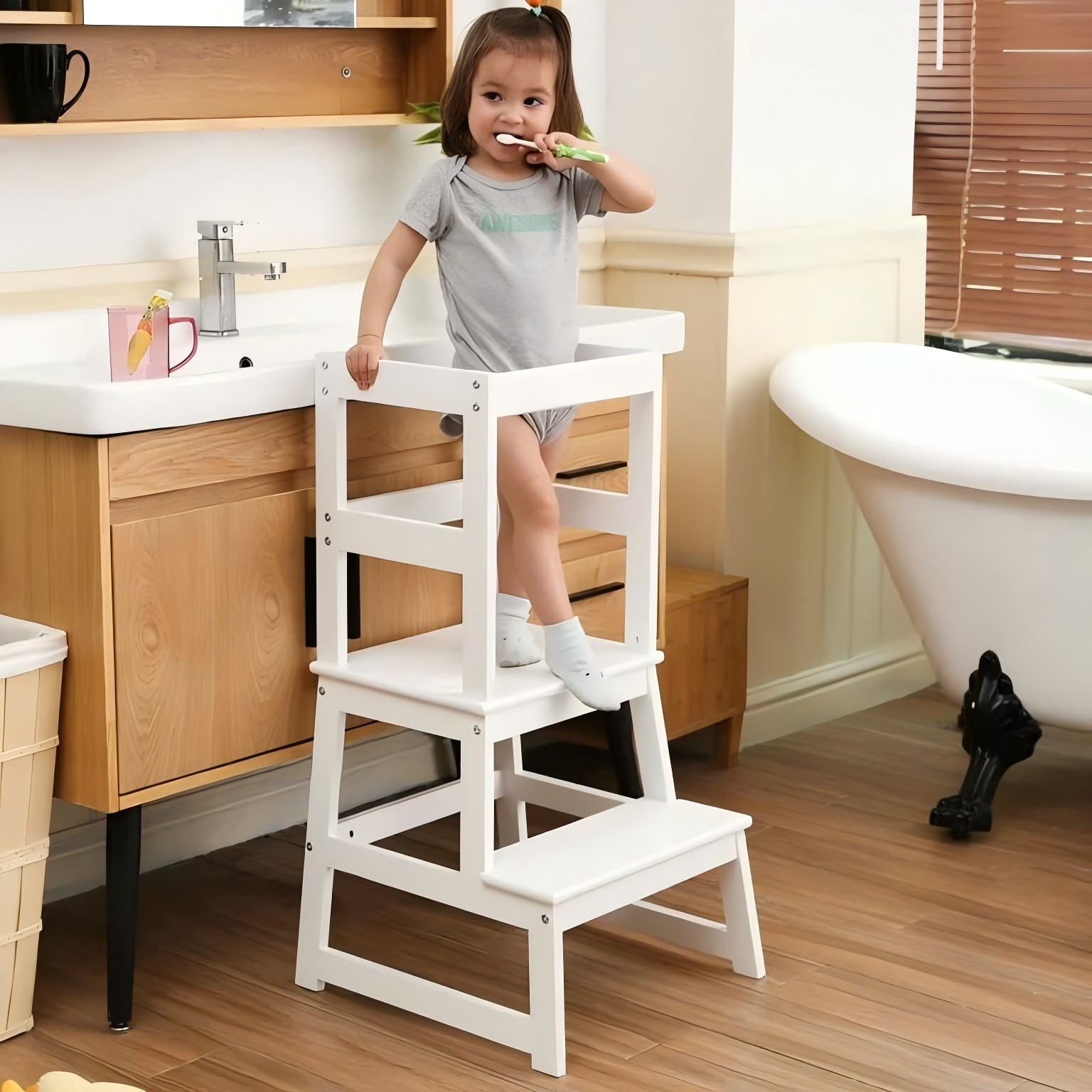
Table of Contents
What Is a Wooden Learning Tower?
A wooden learning tower is a sturdy, enclosed platform designed specifically for young children — typically ages 18 months to 6 years — to stand safely at adult counter height. Unlike a regular step stool or chair, which offers no lateral support and presents a significant fall risk for unsteady toddlers, a learning tower features four-sided railings or enclosed sides that prevent children from toppling sideways or backwards. The child climbs in through a small opening, stands on an adjustable platform, and is then safely enclosed while they participate in kitchen activities, hand-washing routines, craft projects, or simply observe the goings-on of household life.
The concept was popularized by the Montessori educational philosophy, which emphasizes giving children access to real-world activities at their own level. A well-designed learning tower, like those in FORESTOY's Custom Learning Tower collection, raises children safely to counter height while incorporating safety details, functional design, and sturdy construction — making it suitable for any place in the home, from the kitchen to the bathroom to the playroom.
Quick definition: A wooden learning tower (also called a kitchen helper, Montessori tower, or toddler step stool with rails) is an enclosed standing platform that allows young children to safely reach counter height for participation in daily household activities.
7 Reasons Every Family Loves a Wooden Learning Tower
1. Encourages Independence
The developmental leap from dependent infant to independent toddler is one of the most significant transitions in early childhood. Children in this age group are driven by an almost irresistible urge to do things for themselves — to pour, to stir, to wash, to reach. A wooden learning tower empowers kids by giving them a secure platform to explore and engage in tasks that would otherwise be out of reach. This promotes independence as children can actively participate in household activities, such as helping prepare meals, washing vegetables at the sink, or arranging items on a shelf.
When a toddler can stand at the counter and hand you ingredients, stir a bowl of batter, or wash their own hands without being lifted, they experience a profound sense of agency. This is not mere convenience — it is a fundamental building block of self-efficacy. Research in developmental psychology consistently shows that children who are given meaningful, age-appropriate responsibilities develop stronger problem-solving skills, greater emotional resilience, and a deeper sense of responsibility. A toddler step stool transforms the message from "you're too small" to "you're capable" — a shift that ripples through every area of development.
For families looking to foster this independence from an early age, the Kitchen Tower Helper offers a classic enclosed design that balances safety with freedom of movement, allowing children to climb in and out independently while remaining protected by four-sided railings.
2. Enhances Learning Opportunities
Wooden toddler step stools turn daily routines into interactive learning moments. By involving kids in cooking, baking, or cleaning, parents can teach math (measuring ingredients, counting scoops), science (observing how heat changes batter into cake, watching water turn to steam), and essential life skills that no tablet or educational app can replicate. The kitchen, it turns out, is one of the richest learning environments available to a young child — and the learning tower is the key that unlocks it.
Consider the cognitive development that occurs when a three-year-old stands at the counter and helps sort ingredients by color, count the number of eggs going into a bowl, or observe the physical transformation of dough into bread. These are not abstract lessons delivered through a screen — they are embodied, multisensory experiences that build neural pathways through touch, smell, sight, and sound. The concept of learning through play — central to Montessori, Reggio Emilia, and other respected educational philosophies — finds its most practical expression in the daily routines that a learning tower makes possible.
A Montessori helper tower brings children safely to counter height — turning every kitchen activity into a hands-on learning experience.
The tower also supports language development. As parents narrate their cooking — "now we add two cups of flour," "can you hand me the whisk?" — children absorb vocabulary, sequencing concepts, and conversational turn-taking in a natural, low-pressure context. For families committed to fostering intellectual growth through real-world engagement, a learning tower is not a luxury but an educational essential.
3. Safe and Sturdy Design
Wooden toddler step stools are designed with safety as a priority. Unlike makeshift solutions like chairs, overturned buckets, or wobbling plastic stools, a properly constructed learning tower provides a stable and enclosed platform with rails or barriers to prevent falls. The sturdy construction of wood ensures durability, even with energetic toddlers climbing in and out multiple times a day.
The key safety features that distinguish a quality learning tower from a simple step stool include:
- Four-sided enclosure — prevents lateral and backward falls, the most common cause of step-stool injuries
- Wide, stable base — resists tipping even when a child leans to one side
- Non-slip platform — provides secure footing even with socks or bare feet
- Adjustable height settings — allows the platform to be lowered as the child grows, maintaining a safe standing position
- Smooth, rounded edges — eliminates sharp corners that could cause injury during entry and exit
FORESTOY's learning towers are manufactured to meet stringent international safety standards including EN71 (European), ASTM F963 (American), and AS/NZS ISO8124 (Australian/New Zealand). The company's commitment to safety and quality control means that every tower undergoes rigorous testing for structural integrity, material safety, and finish non-toxicity before it reaches a family's home.
4. Promotes Bonding
By bringing kids up to countertop level, learning towers allow them to interact with parents or siblings more closely. This shared experience strengthens family bonds as children feel included and valued in everyday tasks. When a parent is no longer constantly turning away from the child to attend to kitchen work — or worse, lifting a squirming toddler on one hip while stirring with the other hand — the kitchen becomes a shared space of connection rather than a barrier.
Consider the everyday moments that a learning tower transforms: a father and daughter cracking eggs together on a Saturday morning; a grandmother teaching a toddler to knead dough; siblings working side by side to wash vegetables for dinner. These are not grand, planned events — they are the small, repeated interactions that build the foundation of a child's sense of belonging and family identity. The tower makes these moments possible by removing the physical barrier of height difference.
For families with multiple children, a learning tower can even serve as a social equalizer — the older child stands on the ground while the younger one stands on the tower's platform, putting them at roughly the same eye level. This simple physical arrangement naturally encourages cooperation, shared attention, and sibling bonding that would be difficult to achieve otherwise.
5. Durable and Sustainable
Made from high-quality wood, learning towers are built to last. They can withstand years of use and even be passed down to younger siblings. Wood is also an eco-friendly material, aligning with sustainable practices, which makes it a responsible choice for families who are conscious of their environmental impact.
FORESTOY is an FSC™-certified company (FSC™C131173), meaning that all raw materials come from sustainably managed forests that are renewable and responsibly harvested. This commitment to sustainability extends to the use of non-toxic, water-based finishes and biodegradable packaging. For parents who want to model environmental responsibility for their children — the same children who will inherit the planet — choosing a wooden learning tower over a plastic alternative is a meaningful statement about values.
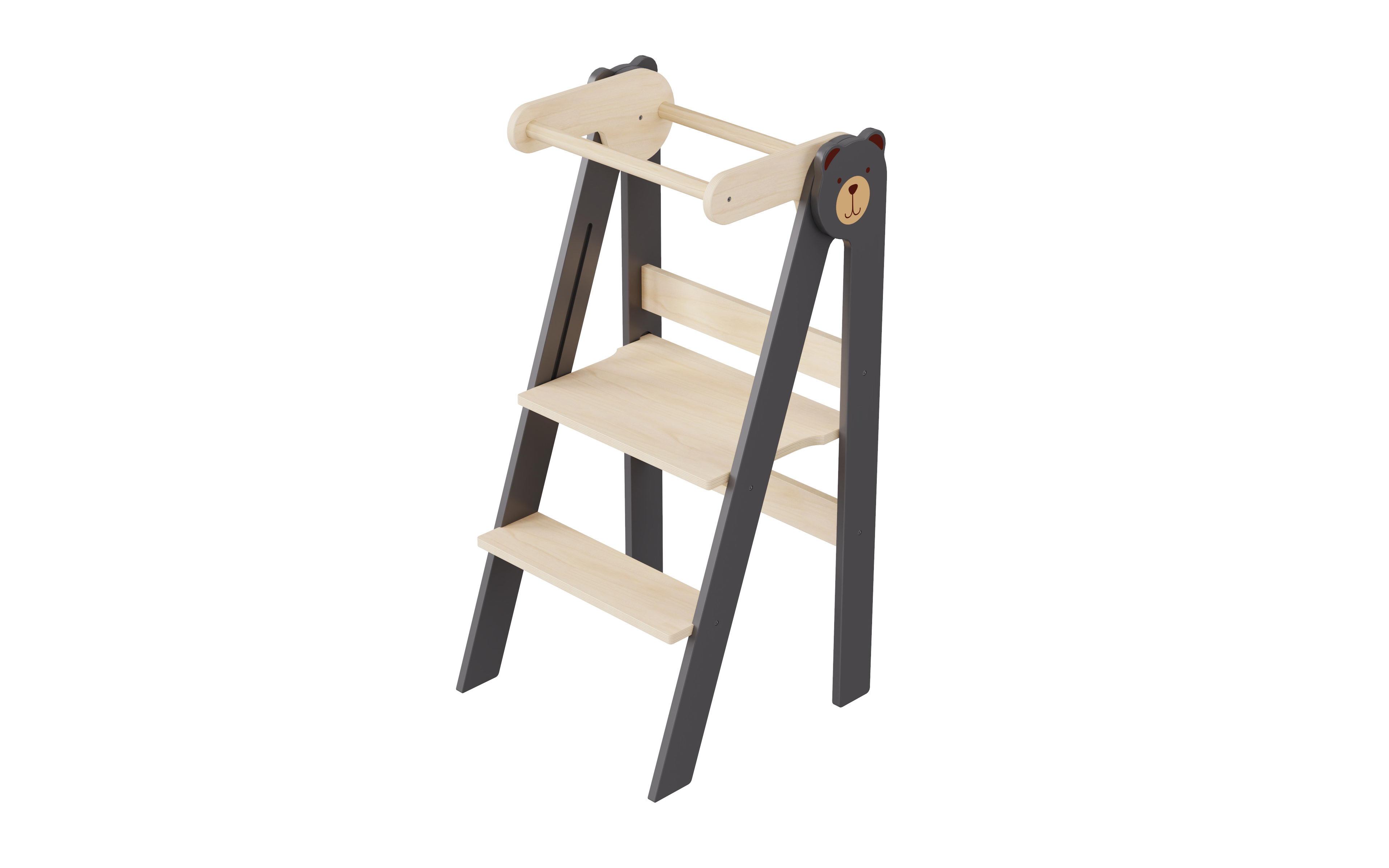
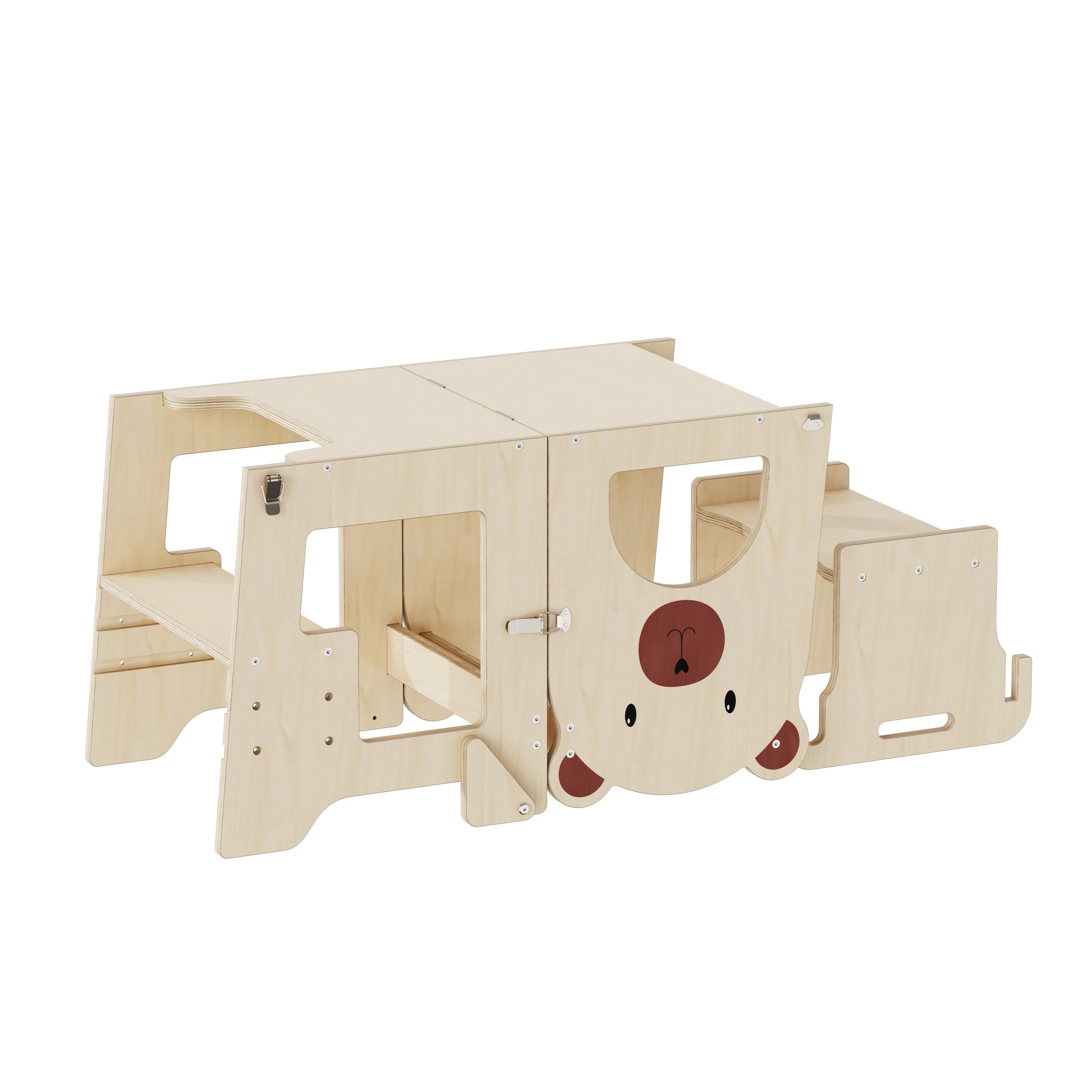
A foldable learning tower combines sturdy safety with space-saving convenience — perfect for homes where every square foot matters.
The durability of wooden construction also makes economic sense. While a plastic step stool might cost less initially, it is far more likely to crack, warp, or degrade within a year or two. A well-made wooden learning tower, by contrast, can serve a family for a decade or more — accommodating multiple children, surviving moves and relocations, and eventually being passed on to friends or relatives. The Foldable Kitchen Helper exemplifies this balance of durability and practicality. Made from high-quality Finnish plywood with PEFC certification, it supports up to 50 kg while folding to a slim 10 cm width for easy storage.
6. Aesthetically Pleasing
Wooden toddler step stools often feature timeless designs and natural finishes that complement home interiors. Unlike plastic alternatives, which tend to come in bright primary colors that clash with adult living spaces, wooden towers blend seamlessly into kitchens or living spaces while offering the same functionality. The natural grain, warm tones, and understated elegance of wood create an object that looks less like a piece of children's equipment and more like a thoughtful piece of furniture.
This aesthetic consideration is not trivial. Parents are more likely to keep a learning tower in a prominent, accessible location — where it will actually be used — if it enhances rather than detracts from the home's visual environment. A tower that is relegated to a closet because it is "too ugly to leave out" serves no one. FORESTOY's custom toddler step stools are designed with this principle in mind, offering customizable finishes that can be matched to kitchen cabinetry, bathroom vanities, or playroom shelving.
For design-conscious families, the learning tower can also be an opportunity to introduce children to the beauty of natural materials. When a child runs their hands along the smooth grain of a wooden tower, they are developing tactile awareness and an aesthetic sensibility that plastic simply cannot provide. This early exposure to quality craftsmanship aligns with FORESTOY's broader mission of creating wooden kids' furniture that is as beautiful as it is functional.
7. Fosters Confidence and Skill Development
As children safely explore new heights and tasks, they gain confidence in their abilities. The learning tower serves as a tool for growth, helping kids develop fine motor skills, coordination, and a sense of achievement as they master new activities. Every time a toddler successfully climbs into the tower, reaches for a spoon, or pours water from one container to another without spilling, they are building a reservoir of self-confidence that translates into every other area of their lives.
The developmental benefits of a learning tower can be categorized across four key domains:
- Physical development — climbing in and out builds gross motor strength, balance, and coordination; manipulating kitchen tools develops fine motor precision
- Cognitive development — following recipes, sequencing steps, and observing cause-and-effect build executive function and reasoning skills
- Social and emotional development — participating meaningfully in family routines fosters self-regulation, patience, and a sense of contribution and belonging
- Language development — the rich, contextual vocabulary of kitchen and household activities accelerates language acquisition in ways that flashcards and apps cannot
For children who are ready to take their exploration even further, FORESTOY also offers a learning tower with an attached slide, which combines the developmental benefits of kitchen participation with the gross motor challenge of climbing and sliding — extending the tower's usefulness well beyond mealtime.
Types of Wooden Learning Towers
Not all learning towers are created equal. Understanding the different types available helps families choose the tower that best fits their space, lifestyle, and child's developmental stage. FORESTOY's Montessori tower collection includes several distinct designs, each engineered for specific needs.
Foldable Learning Towers
A foldable learning tower is crafted primarily from durable wood and features a sturdy, non-slip platform that can typically be adjusted to accommodate different heights, making it suitable for toddlers and young children as they grow. The foldable design is a standout feature, allowing for easy storage and portability — ideal for homes with limited space. When not in use, the tower folds flat to a thickness of just a few inches and can be slipped behind a refrigerator, beside a cabinet, or under a bed.
This design is particularly valuable for apartment dwellers, families with small kitchens, or households where the learning tower needs to be transported between rooms or even between homes. The factory-grade foldable learning tower demonstrates how robust construction and space-saving design can coexist without compromise.
Multifunctional Learning Towers
Both a multifunctional table and convertible helper tower, this design is perfect for Montessori-inspired learning and play. It is designed with playful elements on the side — such as activity panels, peg boards, or chalkboard surfaces — and can even be used in combination with indoor gym equipment for kids. The multifunctional tower recognizes that a child's need for engagement extends beyond the kitchen; by transforming from a standing platform to a play table, it maximizes utility and value.
For families with an eye toward holistic development, pairing a learning tower with wooden indoor gym toys creates a comprehensive physical activity environment within the home. This combination supports the full spectrum of physical development — from fine motor coordination at the counter to gross motor strength on the gym — all within a safe, parent-supervised space.
Themed Learning Towers
Some of the most beloved learning towers feature playful, child-friendly designs that transform a functional piece of furniture into a source of delight. FORESTOY's dinosaur-themed step stool with crown design and the dinosaur-themed folding kitchen helper with wheels combine all the safety and functionality of a standard learning tower with a whimsical aesthetic that makes children eager to climb in. These themed designs are particularly effective for younger toddlers who may initially be hesitant about standing at counter height — the friendly face of a dinosaur turns an unfamiliar experience into an adventure.
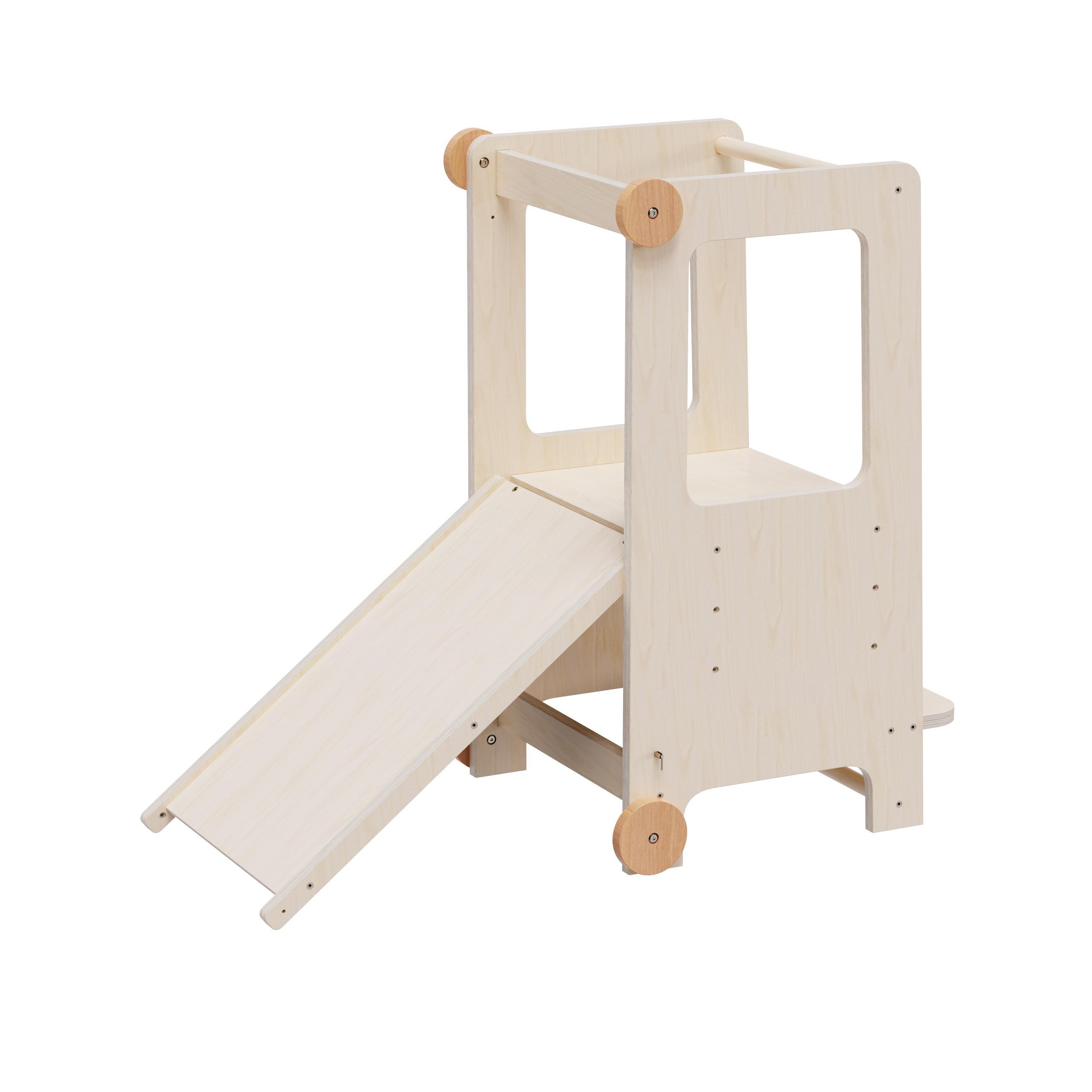
A learning tower with an attached slide extends the tower's value from kitchen helper to active play equipment — growing with your child.
The Montessori Connection: Why Philosophy Matters
The wooden learning tower is deeply rooted in the Montessori educational philosophy, developed by Dr. Maria Montessori in the early 20th century. Montessori education emphasizes independence, self-directed activity, and the child's natural desire to participate in real-world tasks. The learning tower is, in many ways, the physical embodiment of this philosophy — it is a tool that says to the child, "You belong here. You are capable. Your participation matters."
In a Montessori environment, children are not given toys that simulate adult activity — they are given access to actual adult activities, appropriately scaffolded for their size and ability. A learning tower makes this possible in the home kitchen, where the most meaningful daily routines take place. By standing at the counter, a child is not pretending to cook — they are cooking. They are not pretending to wash their hands — they are washing them. This authenticity is a cornerstone of the Montessori approach and a key reason why learning towers have resonated so strongly with families worldwide.
For parents interested in bringing Montessori principles into the home, FORESTOY offers a range of complementary products designed to support the same developmental philosophy. The company's wooden educational toys and pretend play toys extend the learning tower's emphasis on real-world engagement into playtime, creating a cohesive developmental environment throughout the home.
How to Choose the Right Learning Tower for Your Family
With so many options on the market, choosing the right learning tower can feel overwhelming. Here are the key factors to consider when making your decision:
Safety First
Look for a tower with four-sided railings, a wide stable base, and certification to international safety standards (EN71, ASTM F963). FORESTOY's towers meet all of these requirements and undergo rigorous internal and external testing. Learn more about the company's manufacturing capabilities and quality assurance processes.
Adjustable Height
Children grow quickly. A tower with multiple platform height settings will serve your family for years rather than months. The ability to lower the platform as the child grows taller ensures that the standing position remains ergonomically appropriate and safe.
Foldability and Storage
If kitchen space is at a premium, a foldable design is essential. The ability to collapse the tower flat when not in use means it can be stored in a closet, behind an appliance, or under a bed — keeping the kitchen uncluttered without sacrificing access to the tower when it is needed.
Material Quality
Choose solid wood or high-grade plywood over particle board or MDF. Look for FSC or PEFC certification to ensure that the wood comes from responsibly managed forests. FORESTOY's commitment to sustainable sourcing is documented in its company profile and verified through annual FSC audits.
Aesthetic Compatibility
Since the tower will live in your kitchen or living space, choose a design and finish that complements your home. Many FORESTOY towers offer customizable color options to match cabinetry or interior design schemes.
Age and Weight Range
Check the manufacturer's recommended age range and maximum weight capacity. Most wooden learning towers are designed for children ages 18 months to 6 years and support up to 50 kg. The foldable kitchen helper, for instance, specifies an age range of 3+ years and a load capacity of 50 kg.
Safety Guidelines for Using Learning Towers
While a well-designed learning tower is one of the safest ways to elevate a toddler to counter height, proper use is essential. Here are the key safety guidelines every parent should follow:
- Always supervise — a learning tower is not a substitute for adult supervision. A parent or caregiver should be present whenever the child is in the tower.
- Position away from hazards — never place the tower near a stove, oven, sharp knives, hot liquids, or other kitchen hazards. The counter area should be clear of dangerous items within the child's reach.
- Check the platform height — adjust the platform so that the child's waist is approximately at counter height. Too high and they may lean over the railing; too low and they may strain to see over.
- Ensure flat, stable ground — place the tower on a flat, non-slip surface. Never use a learning tower on carpet that may cause wobbling, or on raised thresholds.
- Teach safe entry and exit — show the child how to climb in and out slowly, facing the tower, one step at a time. Discourage jumping or roughhousing while in the tower.
- Regular inspection — periodically check all joints, screws, and platform attachments for tightness. Contact the manufacturer if any component shows signs of wear or damage.
FORESTOY's manufacturing capacity and quality control processes are designed to ensure that every tower meets the highest standards of structural integrity, but proper use and maintenance remain the responsibility of the caregiver.
Ready to Bring Your Child to Counter Height?
Whether you are a brand owner, retailer, wholesaler, or e-commerce seller, FORESTOY has the expertise, manufacturing capacity, and design capabilities to bring your vision for wooden learning towers to life. With over 20 years of experience, FSC™ certification, and a 99% customer satisfaction rate, we are your trusted partner for exceptional wooden toys and children's furniture.
Explore our full range of wooden learning towers and children's furniture, discover our educational toys and indoor gym toys, or learn more about FORESTOY — your trusted partner in sustainable wooden play since 2003. Download our catalog to see our complete product range, or visit our design and development page to learn how we can create custom solutions tailored to your brand.