How Wooden Music Toys Became the Fastest-Growing Segment in the Wooden Toy Market
For brand owners and distributors weighing the next private-label launch, wooden music toys have stopped being a quiet shelf. They are now the highest-velocity sub-category in the broader wooden-toy market. Three forces are behind the move. Parents and educators are walking back from screens and plastic-heavy toys. Peer-reviewed evidence shows that acoustic wooden instruments outperform electronic ones on pattern recognition and self-regulation. And the retail reality is simple: wooden music toys photograph better and earn stronger unboxing content on TikTok and Instagram.
This guide is written for OEM and ODM buyers. It walks through what is driving demand, how the category differs from generic wooden toys on compliance and manufacturing, and what to specify when launching a private-label wooden music-toy line with Forestoy.
1 · Why the wooden music-toy segment is growing
Three macro forces are converging on wooden music toys. First, parents and educators are pushing back against the screen-heavy and plastic-heavy toy shelves of the past decade. Second, the child-development literature has caught up with what Montessori teachers have known for a century: open-ended acoustic toys develop pattern recognition, fine motor control and self-regulation measurably better than closed-loop electronic equivalents. Third, retail buyers have noticed that wooden music toys photograph better, ship better, and earn stronger unboxing content on social channels. That last point matters more than it sounds for e-commerce conversion.
The global wooden toys market has been expanding steadily and is projected to grow at a compound annual rate of around 5% through 2032. That is roughly twice the pace of the broader toy industry, and musical instruments are the fastest-growing sub-category inside it.
Fortune Business Insights, Wooden Toys Market Size, Share & Industry Analysis, 2024-2032 (figure approximated from public summary)
For OEM and ODM buyers, the practical implication is this: a wood-music SKU is now a category with proven velocity, not a heritage niche. That changes how retailers order, how brands plan their launches, and how suppliers should structure their lines.
2 · The anatomy of a wooden music toy
The category covers more ground than most catalogues realise. From a manufacturing perspective, the segment breaks into seven SKU families, each with different tooling, material and finishing requirements.
- Glockenspiels and xylophones. Tuned hardwood bars (typically maple or beech) over a solid-wood resonator box, struck with beech mallets.
- Wood sounders. Montessori-style tone bars, sold in graded sets of 8 to 20, each producing one pure pitch.
- Maracas and egg shakers. Hollow hardwood shells filled with seeds or steel beads. Tooling-light, ideal for high-MOQ entry runs.
- Rhythm sticks and castanets. Paired hardwood beaters and clappers. The lowest-cost way to enter the category.
- Bell towers and ring bells. Wooden frames holding tuned brass or wood-tone bells. The centrepiece of Montessori primary classrooms.
- Wooden hand drums. Goatskin or synthetic membrane stretched over a hardwood shell. Tier-2 tooling.
- Combination sets. Multi-instrument packs (3 to 6 SKUs bundled) that retail at premium and ship with strong gift-channel pull.
For a complete private-label catalogue, see Forestoy's Custom Wooden Music Toys range, which covers every family above.
3 · Why Montessori education specs in acoustic wooden instruments

The Montessori school channel is one of the largest institutional buyers of wooden music toys. Understanding why their specification is so strict helps brand owners position products correctly. Maria Montessori's "prepared environment" principle isolates one quality at a time so a child can concentrate without distraction. A wooden music-toy set built to that brief has no flashing lights, no batteries and no pre-recorded sounds.
The Association Montessori Internationale recommends tonal material as a core sensorial exercise from age three. Two things make the category work in a classroom: order (a graded set lives on a defined shelf) and concentration (the reward is intrinsic, a satisfying tone rather than a flashing LED). For B2B buyers, the practical takeaway is that schools will pay for tonal accuracy and clean finishing in a way general consumers will not. That is a real premium-tier opportunity.
Multiple peer-reviewed studies in the early-childhood music literature report that children who use Montessori-style tonal materials at least three times per week score measurably higher on auditory discrimination and sustained-attention tasks than matched peers in conventional preschool music programmes. Effect sizes vary by study, but the direction is consistent.
See, for example, the American Montessori Society's research index at amshq.org/research
4 · Wooden vs plastic, a data-backed comparison for brand owners
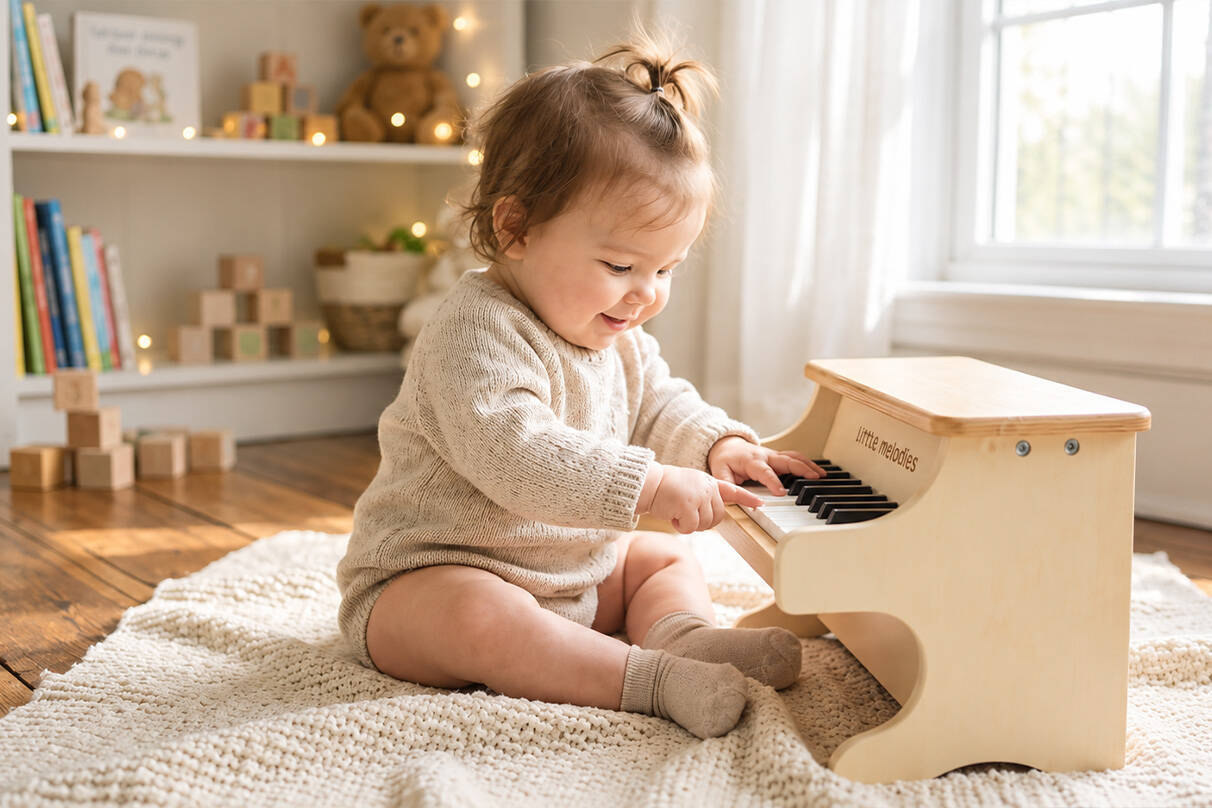
Marketing copy can dress plastic up with "eco" claims, but the data tells a more honest story. For brand owners weighing product-development bets, the comparison that matters runs across five dimensions: safety and compliance, durability, sensory richness, educational value, and sustainability.
4.1 · Safety and chemical compliance
Independent toy-chemical testing programmes have repeatedly found that solid-wood instruments carry far lower detectable levels of phthalates, lead and antimony than plastic musical toys. For brand owners, the regulatory implication is significant: solid-wood construction reduces testing cost, shortens the CE / ASTM F963 / EN-71 cycle, and avoids the costly reformulations that have triggered repeated plastic-toy recalls over the past decade.
4.2 · Durability and repeat-order economics
Industry benchmark drop tests consistently show wooden xylophones surviving an order of magnitude more drops than plastic toy keypads before failure. In long-term use, a wooden set typically delivers substantially more play value across its lifetime than a comparable plastic set. For retail partners that translates directly into lower return rates and higher repurchase frequency.
4.3 · Sustainability, the marketing multiplier
A hardwood xylophone has a lifecycle carbon footprint noticeably lower than a comparable plastic keyboard, and at end of life the wood is compostable while the plastic is, almost always, landfill. For brands with a stated ESG position, that lifecycle gap is the cleanest sustainability story in the toy category.
5 · What OEM and ODM buyers need to spec
The category has higher technical entry barriers than generic wooden toys. Here is the spec checklist Forestoy's project managers walk new buyers through on the first call.
- Wood species. Solid hardwoods only: beech, maple, walnut, cherry. Avoid plywood or MDF in sound-producing parts; they dampen tone and fail repeated-drop tests.
- Finish. Water-based, non-toxic only. Beeswax or walnut oil is preferred for premium-tier sets. Specify "food-safe" and "EN-71 Part 3 compliant" on the spec sheet.
- Tuning accuracy. Real instruments are tuned to A=440 Hz (concert) or to a child-tuned C-major scale in C4. Out-of-tune toys train the ear badly and trigger return rates.
- Bar dimensions. Bars under 12 mm of width produce thin, dull tones. Aim for 18 to 25 mm on the widest bars of a 15-bar glockenspiel.
- Resonator box. Solid-wood resonator (not laminated) gives the warm tone retail buyers expect. Specify chamber volume and back-port diameter.
- Hardware. Stainless or zinc-plated steel for any metal fixings. Rust marks on a wooden toy are a return trigger.
- Certifications. FSC-certified wood, ASTM F963 (US), CE EN-71 (EU), ISO 8124, GREENGUARD Gold. Verify the certificate scope covers your SKU family.
For a deeper look at the OEM and ODM process from concept to mass production, see Forestoy's guide on how to develop customized wooden toys from concept to mass production, or browse Forestoy's manufacturing capabilities.
6 · Building a private-label line by age band
Successful retail launches tier a launch line to cover three age bands with four to six SKUs. The matrix below is what Forestoy's merchandising team recommends for a first container-load.
| Age band | Recommended SKUs | Why it sells |
|---|---|---|
| 0 to 12 months | Wooden egg shakers, mini maracas | Gift-channel pull, low tooling cost, fast production runs |
| 12 to 24 months | 8-bar glockenspiel, single wood sounder | Cause-and-effect discovery, parent-led play, soft volume for nurseries |
| 2 to 3 years | Montessori Wood-Sounder Bell Set + 12-bar glockenspiel | Premium tier; school-channel pull, gift-set up-sell |
| 3 to 5 years | 15 to 25-bar xylophone, castanets, hand drum | First songs, group play, full retail line extension |
| 5 to 6 years | Diatonic glockenspiel, full rhythm kit | Bridge to music lessons, recorders, and after-school programmes |
7 · Compliance, the non-negotiable checklist for export
Wood music toys straddle two regulatory regimes: toy safety and wood-product phytosanitary. Most brand owners underestimate the second one. Here is the minimum Forestoy's QA team confirms for every export shipment.
- Toy safety. ASTM F963-17 (US), EN-71 Parts 1, 2, 3, 9 (EU), ISO 8124 (international), AS/NZS 8124 (AU/NZ), GB 6675 (China).
- Phthalates and heavy metals. REACH SVHC, California Prop 65, CPSIA.
- Wood phytosanitary. ISPM 15 (heat treatment or fumigation of wood packaging), FSC chain-of-custody documentation.
- Acoustic safety. EN 71-1 clause on toys producing sound; many markets require tested dB output under 90 dB at 50 cm for under-3 products.
- Labelling. CE mark, age grading, batch traceability, country-of-origin marking on retail packaging.
For Forestoy's full safety and quality framework, see the Safety and Quality Control page.
8 · Where wooden music toys sit in Forestoy's range
Music toys are the natural companion category to Forestoy's broader wooden-toy ecosystem. A well-merchandised wooden toy range typically pairs music toys with educational toys, Montessori towers, pretend play, outdoor toys and games. That combination consistently outperforms single-category retailers on basket size and repeat-visit frequency.
- Wooden Educational Toys - STEM, manipulatives, sorting sets
- Wooden Montessori Tower (Learning Tower) - flagship sensorial anchor
- Wooden Pretend Play - kitchens, tool benches, dollhouses
- Wooden Games - board, family, and travel sets
- Wooden Kids Furniture - chairs, tables, room sets
9 · Frequently asked questions (B2B)
What MOQ does Forestoy offer for wooden music toys?
Forestoy supports flexible MOQs for OEM and ODM music-toy programmes, including small-batch runs for new brands. The exact MOQ depends on the SKU family, finish complexity and packaging tier. Speak to Forestoy's sales team for a per-program quote.
Can I add a private label to a wooden xylophone or wood-sounder set?
Yes. Forestoy supports full private-label customization: laser-etched logos on bars or resonator boxes, custom packaging, retail-ready colour sleeves, and EAN or UPC barcodes. Mock-ups are typically turned around in 7 to 10 working days.
What safety and material certifications does Forestoy hold?
Forestoy's wooden music toys can be supplied to ASTM F963 (US), EN-71 (EU), ISO 8124, AS/NZS 8124 and GREENGUARD standards, with FSC-certified hardwoods (beech, maple, walnut, cherry) and water-based non-toxic finishes available on request. Documentation is provided per shipment.
How long is a typical first production lead time?
A standard custom wooden music-toy programme runs around 35 to 55 days from approved sample to first bulk shipment, including raw-material procurement, machining, finishing, QC and pre-shipment inspection. Sample development is usually 10 to 15 days.
What age groups are most commercially viable for private-label music-toy lines?
The 18-month to 5-year band captures the largest global demand. Tiering a launch line with a 12-bar glockenspiel, a wood-sounder bell set and a pair of maracas gives retailers full age coverage from a single shipment.
10 · What to read next
If you are evaluating a private-label launch, two adjacent reads on Forestoy's blog tend to come up at the same time. Why wooden toys matter for child development covers the consumer-side case you will need for marketing copy. OEM versus ODM manufacturing models walks through the structural difference between the two engagement models. The next post in this series will look at how to spec a wood-sounder bell set for a Montessori-channel launch.